
Abenaqui Country Club
One of New Hampshire's most precious courses shines as a championship host

As you travel up the New Hampshire seacoast on Route 1A in Rye, eventually you will see a sign on the left for Central Rd. What you will also see at that same turn is a sign hanging from a post pointing towards one of New Hampshire’s most historic and storied golf courses: Abenaqui Country Club.
Golf has been played at Abenaqui Country Club going back before the year 1900, and the course has taken on many shapes in forms over its long history. Architects including Arthur Fenn, Alexander Findlay, Geoffrey Cornish, Al Zikorus, and Mark Mungeam have all had a hand in shaping the layout found there today, and the likes of Walter Hagen and Gene Sarazen have played there.
The walk at Abenaqui Country Club is one of the most pleasant one can find in New England golf. The course itself sits just inland from the Atlantic Ocean, and its routing moves its way through open land on the front nine away from and back to Central Rd, and then through the open areas into woods and wetlands on the back nine.
Most of the holes on the front nine run parallel to each other, yet they feel well isolated and unique from one another, and the ways the water hazards are shaped and placed are quite genius. The variety of the greens found here is also quite stunning and is a true reflection of how many wonderful architects have developed the course.
The opening hole at Abenaqui is beautiful mid-length par-4, playing straight way from the club’s wonderful yellow clubhouse. The hole would appear to be quite simple in that there is not a single bunker found on the hole, even up at the green, but the hole’s fairway rolls up and down in many subtle ways that can provide some tricky lies, and trees line the right side of the hole. The green is draped right over the natural land it sits on, and while it appears to be flat, it slopes from right to left, making a right pin position the most interesting to hit and putt to.


Running along the left side of the first hole and moving back towards Central Rd is the second hole, which also happens to be the course’s first par-5 hole. It takes about 270 yards to clear the two fairway bunkers on the left side of the hole entirely, and the approach from here introduces the player to the first instance of Abenaqui’s stellar use of water. At about 100 yards from the green, a creek meanders its way up and across the hole, eventually expanding into a small pond. A small section of grass separates this pond from another, which wraps its way around the right and back of the hole’s slightly raised green. If hitting the green is attempted on the second shot, the water is perfectly situated to capture a weak fade.
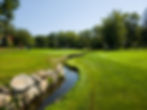

One of the course’s most challenging par-4 holes is encountered next on the third hole. This hole plays a strong 405 yards, featuring a tee shot that requires a solid strike to a raised fairway and one that avoids the trees on the right. The fairway slopes from left to right at the highest point, features many tricky lies, and the approach is to a green that is well guarded by a large bunker on the right, and a steep slope on the left side. A par on this hole, especially with a left side pin placement, is one well earned.


The first of Abenaqui’s wonderful par-3 holes is hole #4. The hole plays short at typically around 150 yards from the back tee, and the green here is enormous, being about 40 yards deep. While this may seem to make the hole easy, the hole provides significant penalties for not hitting the green. Two bunkers are positioned perfectly on the front and back-left of the putting surface, and off the right side there are several dips and mounds with thick rough that provide difficult lies to try to get up and down from. Hitting the green at the wrong section from the flag can also make for a difficult two-putt, so a precise short iron here is of upmost importance.


From the fourth green, the course moves across the road to the fifth tee box. Hole #5 is the second par-5 hole at Abenaqui. Playing at 560 yards from the back tee, the tee shot here brings many elements into picking the right line. Trees are found on the right side of the hole, and the hole’s first of three staggered water hazards lurks beautifully on the left. A slight fade off this water is ideal, but a big hitter could easily lose a ball in it with an errant shot. As the hole progresses, the fairway routes in between two more water hazards, one on the right shared by the nearby 11th green, and another that starts at about 100 yards from the center of the green. These two ponds are perfectly situated to test where a layup shot is played to, and the green is well sloped and protected by bunkers on both sides. It is a brilliantly designed hole and one to look back on when moving to the next tee.




The sixth hole is a mid-length par-4 that features several interesting obstacles off the tee. On the left side of the hole, the first major pond encountered on the previous hole is well in play, and further up to the right, the hole features a series of several mounds in the rough. The fairway is routed elegantly between these elements, moving left and then right up to a slightly elevated green that is initially pitched from back to front, and then crests and falls away slightly off the back.


Following the wonderful sixth hole is the equally special par-4 seventh. The back tee of this hole is situated just off the road behind it and forces the player to send a tee shot through a narrow opening between two beautiful trees. At 430 yards, a strong tee shot to the fairway guarded on the left by a row of trees is paramount, as the approach is well guarded by a greenside bunker with a mound to the right and another large mound to the left. It is easy to see how this hole plays as the fifth hardest on the club’s scorecard.
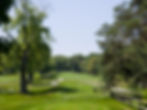

The opening shot of the eighth hole plays over a stretch of tall native grasses that block the compete view of the fairway, and with tall willow trees on the left and a substantial pond immediately in play on the right, it is one that demands precision. The pond on the right stretches nearly all the way to the green, and the putting surface is large with several different sloping sections. This, coupled with its roughly 30 yards in depth, makes it quite challenging and capable of being set up in many ways, and a bunker right and large mound left add to an already tricky approach shot.


Abenaqui’s front nine finishes with a beautiful par-3 hole of 186 yards. The enormous pond from the eighth hole looms directly in front and to the right from the tee, requiring about 150 yards to safely carry. A second pond is found front and left as well and a cross bunker in front of the green is also required to carry to make it to the putting surface. There is some room here to miss out to the right, and there is very little area to work with left of the hole. It is a par-3 that demands precision and is a tremendous hole to close the first nine of the course.

Directly behind the ninth hole and playing along two roads is the par-5 10th hole. This hole features a hard dogleg that moves from left to right, and although the water is not much in play in front of the tee, a bunker at the outside of the dogleg is around the 250-yard mark. The inside of the dogleg is protected by a thick area of trees, and the fairway falls away to the right as the dogleg starts. The approach into the green plays up and down a small ridge at first, and a tree looms over the approach if the green is attempted on the second shot. The miss here is certainly right, as long or left can be out of bounds, or end up in a deep bunker.
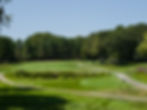


The next par-3 hole is found on the 11th. This is another strong short hole, playing 185 yards to a green that is built in a diagonal manner up one of the ponds encountered previously on the fifth hole, and it is perfectly designed to punish a weak fade from the tee. Anything in the middle of the green here is a fine shot. The stones at the edge of the water here frame the green quite beautifully as well and help establish it was one of the most visually appealing on the golf course.

The last hole played before crossing the street back to the initial area of the course is the robust par-4 12th hole. While the water on this hole is not really a factor at the forward second of tees, it is a required carry from the back tee and requires playing the tee shot at a more difficult angle rather than playing straight up the fairway. The approach to the green, which is entirely uphill, is pinched in by two significant mounds, and smaller mounds are found in the rough to the right.

After crossing the street back to the first area of the course, the 13th hole plays with this street down its left side. A row of hedges and powerlines line the left side of the tee shot and there are additional trees to the right, creating an interesting visual chute to hit through. The fairway cannot be seen from the tee, but it moves gradually downhill at first, takes a somewhat sudden drop, and then starts to flatten out towards the green. This green is one of the most heavily bunkered on the course, with two found to the left and a large one stretching nearly across the entire front and to the right. The green is quite large from left to right and flows and slopes in many ways.


Hole #14 is a demanding par-4 that plays as a right to left dogleg and back towards the clubhouse before the course moves to a completely new environment. This hole provides an intimidating tee shot from the back tee. A row of trees protects the right side of the hole quite well, and a considerable fairway bunker with a raised outside perimeter comes into play at about 250 yards. The hole then moves sharply to the left to present the green, and although there are no bunkers or real hazards up at the green, it features a subtly crowned and pitched surface. These elements all add up to make this the fourth hardest hole on the scorecard.


From here, the course moves into an entirely different section of the property for the closing stretch. The 15th hole is a short par-4 at just over 300 yards and moves from right to left around dense trees. A fairway bunker comes into play at around the 200-yard mark, the approach to the green requires a carry over another bunker with an interesting raised front section. The green falls away steeply and quickly off the back, and there is very little room to miss left as well.

The 16th hole is the last of the terrific par-3 holes at Abenaqui, and it plays at around the same distance as the fourth hole at 155 yards. Two bunkers of considerable size guard the front left and right of the putting surface, and the left side bunker perfectly conceals the fact that the left side of the green drops off considerably into thick rough. A well stuck short iron away from this section of the green is certainly the play, and a par here is very desirable before the course’s challenging finish.


After a small walk through the woods to the corner of the course’s property, the par-5 17th hole is revealed, and it is a spectacular test. As before with some of the holes on the course, the back tee uses not only length, but angles to set up a demanding tee shot, forcing players to hug dense trees on the left if they try to fade it into the fairway. From this tee, a creek that runs diagonally up the hole begins to come into play around the 280-yard mark for a long driver of the ball, and the hole then moves to the left for the second section. If the green is attempted on the second shot, a considerable hazard and bunker must be completely carried, and the only room to miss is on the left, which also needs at least a carry of 200 yards to safely clear. These elements plus a challenging putting surface make this hole perhaps the course’s most demanding.


The final hole at Abenaqui is a 420-yard par-4 that plays entirely on the boundary of a body of water called Burke Pond. The tee shot here is exceptionally tough, with a carry of around 200 yards to reach the fairway over the first cross hazard, and the pond looms to the left. The hole continues to wrap around the edge of the pond, and the approach to the green requires a near-complete carry over the pond on its left side. Certainly, if in any doubt, missing out on the right will not induce a penalty, but the green from this part of the hole is raised up significantly, and will call on short game precision for a score of four. It is a tremendous finishing hole that provides the conclusion to a special round.


Abenaqui Country Club is a place where history can be felt under every step, and it is truly one of New Hampshire’s most special and historic clubs. The course has endured in so many ways over its long history, not only as a wonderful layout that has evolved architecturally over its incredible history, but also as a course that has provided a stage for New Hampshire’s best amateurs since its first hosting of the New Hampshire Amateur Championship in 1907. This year, the course was the site of the 2026 New Hampshire Women’s Amateur Championship, an honor it was first awarded in 1982, and it shined once again as a championship venue.

If an opportunity presents itself to visit and play the course, The New England Player advises you to make the effort needed to be there. It is an experience to savor, and one that is undoubtedly pleasant.